Institutional Perspectives on Global Private Capital
Research and analysis on private markets, institutional capital allocation and investment developments across the UK, the GCC and international markets.
UAE Private Capital 2026: Sovereign Wealth Funds, Family Offices and Their Investments
Mubadala was the world's most active sovereign investor in the first nine months of 2026, and MGX closed a US$49 billion AI fund. This briefing profiles the UAE's sovereign wealth funds, AI vehicles and family offices: their size, sectors, ticket sizes and publicly announced 2026 investments.
A UK-GCC Private Capital research briefing.
The UK: A Global Centre for Private Capital 2026
London hosts 46 major sovereign wealth and public pension institutions, and UK-based managers oversee £10 trillion of assets. This research briefing maps the sovereign capital, leading private equity and private credit managers, and the 2026 transactions that make the UK a global centre for private capital.
A UK-GCC Private Capital research briefing.
Saudi Arabia Private Capital 2026: PIF, Family Offices and Their Investments
PIF deployed US$14.0 billion in the first nine months of 2026 and approved a 2026–2030 strategy directing 80% of deployment at home. This briefing covers PIF and the Saudi sovereign stack, HUMAIN's AI partnerships, family offices and their publicly announced investments.
A UK-GCC Private Capital research briefing.
Qatar Private Capital 2026: QIA, Family Offices and Their Investments
The Qatar Investment Authority announced a run of AI-infrastructure investments in 2026 and launched a wholly owned domestic investment platform. This briefing covers QIA, Qatar's AI investors and funds, family offices and family businesses, and their publicly announced investments from January to October 2026.
A UK-GCC Private Capital research briefing.
Kuwait Private Capital 2026: KIA, Family Offices and Their Investments
Kuwait's sovereign wealth fund co-launched the US$10bn+ Helix AI infrastructure platform with NVIDIA and KKR in 2026, while Kuwaiti family-business groups are professionalising their investment operations. This briefing covers the Kuwait Investment Authority, Kuwait's AI vehicles, family offices and venture managers, and their publicly announced investments from January to October 2026.
A UK-GCC Private Capital research briefing.
Bahrain Private Capital 2026: Mumtalakat, Investcorp, GFH and Family Offices
Bahrain pairs a compact sovereign holding company, Mumtalakat, with two global asset managers headquartered in Manama, Investcorp (US$64 billion AUM) and GFH, and a formal regulatory framework for family offices. This briefing covers the sovereign fund, asset managers, AI investors and family offices behind Bahrain's private capital, and their publicly announced investments from January to October 2026.
A UK-GCC Private Capital research briefing.
Oman Private Capital 2026: OIA, Future Fund Oman and Family Offices
Oman pairs the Oman Investment Authority, which closed 2025 with assets of roughly US$60 billion and a record RO2.9 billion profit, with Future Fund Oman, its development investment vehicle established in 2024 with US$5.2 billion of capital. This briefing covers the sovereign fund, AI investors and family offices behind Oman's private capital, and their publicly announced investments from January to October 2026.
A UK-GCC Private Capital research briefing.
Germany Private Capital 2026: Carve-Outs, SME Succession and Gulf Capital
Private equity deal volume in the DACH region (Germany, Austria and Switzerland) rose 69% to €88.3 billion across 557 deals in 2025, and 66% of European private equity firms surveyed now hold investments in Germany, up from 58% a year earlier (PwC Private Equity Trend Report 2026). Carve-outs, SME succession and green industrial transformation are the priority German themes for 2026, and this briefing covers the German managers, institutions and family offices engaging with the UK and the GCC.
A UK-GCC Private Capital research briefing.
United States Private Capital 2026: Private Equity, Private Credit and Gulf Capital
US private equity deal value reached about $1.2 trillion across more than 9,000 deals in 2025, and funds focused on North America raised $87 billion of the record $240 billion of private credit capital raised globally (CBH Private Equity Report; With Intelligence). Almost half of the capital committed by Gulf sovereign wealth funds in the first half of 2026 went to the US (Global SWF), and this briefing covers the US managers, institutions and family offices engaging with the UK and the GCC.
A UK-GCC Private Capital research briefing.
GCC Real Assets, Capital Flows, and Post War Geopolitical Transformation
The global investment landscape is undergoing a profound transformation. Capital is no longer confined to traditional financial centres but is increasingly reallocating toward regions that offer structural advantages in stability, regulation, and long-term growth. Among these, the Gulf Cooperation Council (GCC) has emerged as a compelling destination for both real estate and institutional investment. This shift is not incidental but reflects deeper macroeconomic, geopolitical, and financial realignments that are reshaping global capital flows.
With over three decades of experience spanning asset management, investment banking, and wealth management—and as an active real estate investor in Dubai since 2002, alongside investments across mature markets in the United Kingdom and Europe—I have observed firsthand how global capital identifies and concentrates in structurally advantaged regions. It is increasingly clear that the GCC offers a uniquely compelling investment proposition. Unlike many emerging markets, the region combines regulatory clarity, robust legal frameworks, and investor-centric policies with strong macroeconomic stability. This powerful convergence has elevated the GCC from a peripheral opportunity to an increasingly core allocation destination within global investment portfolios.
Read moreShow less
However, while the region’s structural strengths are undeniable, it is critical to recognise that capital does not automatically flow to attractive markets—it flows to accessible, visible, and institutionally aligned opportunities.
Structural Drivers of Capital Migration into the GCC
One of the most significant drivers of this transformation is the structural migration of wealth. Recent global wealth reports consistently highlight the UAE as a leading destination for high-net-worth and ultra-high-net-worth individuals. This influx is underpinned by favourable tax regimes, including the absence of capital gains and income taxes in most jurisdictions, as well as the ease of conducting transactions. Property ownership systems have become increasingly transparent, with digitised registries and enforceable title structures that reduce legal uncertainty for international investors.
Furthermore, macroeconomic stability plays a critical role in reinforcing investor confidence. Many GCC currencies are pegged to the US Dollar, effectively mitigating foreign exchange risk and aligning the region with global financial systems. This stability, combined with high levels of safety and political security, creates an environment in which capital can be deployed with confidence.
Importantly, the fundamental demand drivers of the region remain firmly intact. Population growth, expatriate inflows, urban expansion, infrastructure development, and economic diversification programmes continue to underpin sustained demand across residential, commercial, hospitality, and logistics real estate sectors. These are not cyclical trends—they are structural forces that will persist over the long term.
Real Estate Cycles: Corrections as Strategic Entry Points
Despite these strengths, the GCC real estate market remains subject to cyclical dynamics, as is characteristic of all asset classes. However, historical evidence suggests that corrections within the region tend to be relatively short-lived and often present strategic entry points for investors. The downturn following the Global Financial Crisis, as well as the adjustment during the COVID-19 pandemic, both illustrate this pattern. In each instance, markets experienced sharp corrections followed by relatively rapid recoveries, driven by renewed capital inflows and strong underlying demand.
At present, the market appears to be entering a phase of price recalibration. Growth is moderating, and investors are becoming more selective. Importantly, this does not signal a structural downturn but rather a transition toward a new accumulation phase.
Institutional investors are not withdrawing from the region. On the contrary, they are waiting with significant undeployed capital, preparing to enter the market at more attractive valuations. This creates a window of opportunity—but only for those positioned to capture it.
Institutional Capital Gap and the Need for Market Evolution
A notable inefficiency within the GCC real estate sector lies in its continued reliance on retail-driven models. Many developers focus predominantly on individual buyers, off-plan sales, and short-term liquidity generation. While this model has historically supported rapid growth, it is increasingly misaligned with the expectations of institutional capital.
Large-scale capital allocators—including private equity firms, sovereign wealth funds, pension funds, insurance companies, and family offices—operate under fundamentally different requirements. Their investment decisions are driven by scale, governance, transparency, long-term income stability, and risk-adjusted returns.
This creates a structural disconnect: while capital availability is abundant, the supply of institutional-grade investment opportunities remains limited.
However, this gap should not be misunderstood as a passive opportunity. It does not imply that capital will automatically flow into the region. Rather, it highlights the need for developers and operators to actively evolve their approach—structuring assets, aggregating portfolios, and aligning with institutional standards.
Global Capital Repositioning and the Rise of Tactical Allocation
This structural shift is occurring alongside a broader reallocation of global capital. Over the past decade, significant investment has flowed into private credit, particularly in technology and software-focused strategies. Today, however, that trend is reversing.
Capital is exiting:
- Over-concentrated software and growth credit strategies
- Highly leveraged, intangible asset classes
- Segments facing refinancing pressure and declining returns
At the same time, increasing redemptions and liquidity pressures in private credit, can drive investors toward more stable, asset-backed alternatives.
Within this environment, Tactical Asset Allocation (TAA) has become a dominant framework. Investors are dynamically reallocating capital to capture short-term dislocations, respond to macroeconomic shifts, and optimise portfolio performance.
In a world defined by:
- Elevated interest rate volatility
- Slowing growth in developed markets
- Persistent geopolitical uncertainty
real estate in the GCC will emerge as a high-conviction tactical allocation post war.
Post-Conflict Stabilisation and the Reality of Capital Deployment
A key inflection point for capital deployment will be the stabilisation of geopolitical tensions involving the United States, Israel, and Iran.
As these tensions subside, several dynamics are likely to unfold:
- Risk premiums across the region will decline
- Investor confidence will strengthen
- Delayed capital deployment will accelerate
At the same time, special situations and opportunistic capital will actively seek to capture dislocations created during the period of uncertainty. This capital will target income-generating, asset-backed real estate opportunities offering both yield and capital appreciation—often at valuations more attractive than those available in developed markets.
However, it is critical to emphasise that this capital will not be passively distributed across the market.
It will not “arrive” broadly.
It will not “discover” opportunities independently.
It will be allocated selectively, based on:
- Relationships
- Track record
- Credibility
- Access
- And direct engagement
From Opportunity to Execution: The Role of Access
The implication for GCC real estate developers is clear. The opportunity is real, and the fundamentals are strong—but access to capital is not automatic.
Institutional capital is deployed through:
- Established networks
- Trusted relationships
- Curated platforms
Developers who continue to operate within purely retail frameworks risk being excluded from this capital flow, regardless of the quality of their assets.
To capture this opportunity, market participants must:
- Engage directly with private capital allocators
- Understand institutional investment criteria
- Position themselves within relevant investment networks
- Build long-term relationships with global investors
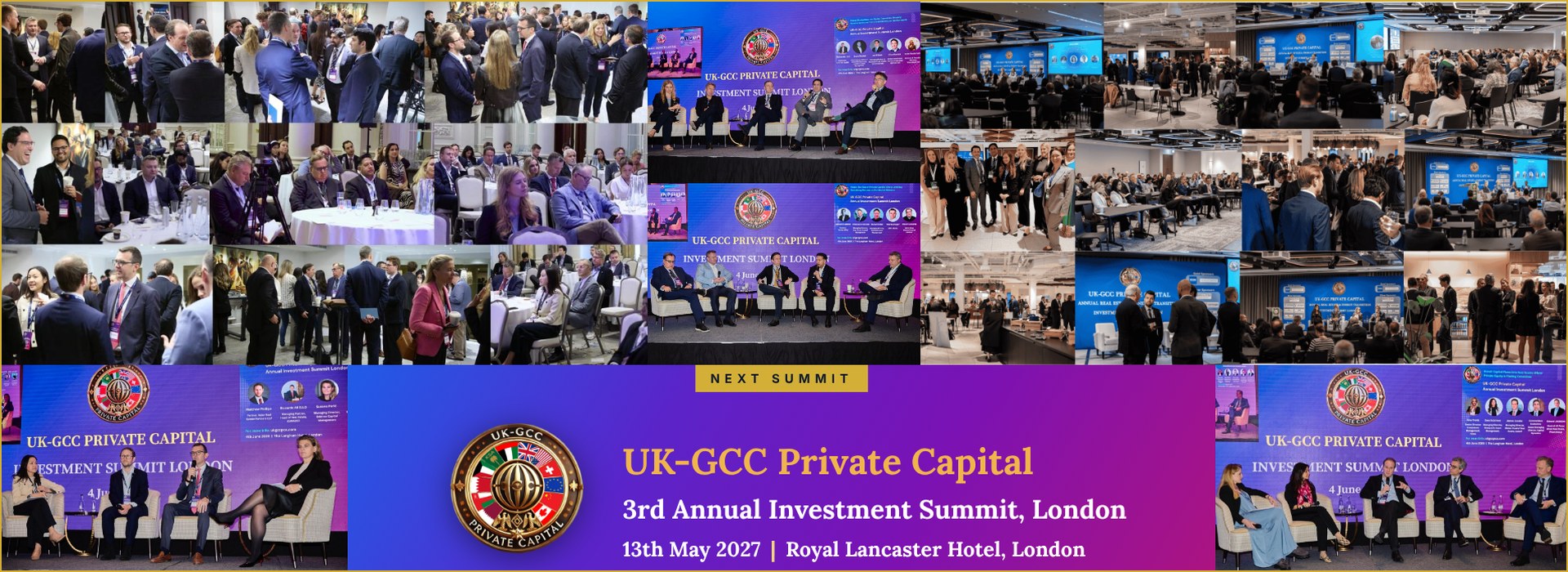
Platforms such as the UK–GCC Private Capital – Investment Summit in London Langham on 4th June, are designed precisely for this purpose—bringing together capital allocators and operators within a structured environment where investment decisions are initiated.
A Generational Opportunity—But Not a Passive One
The GCC stands at the intersection of powerful global trends: capital reallocation, real estate cycle adjustment, infrastructure expansion, and geopolitical transformation. Together, these forces are creating a generational investment opportunity.
The region offers:
- Strong and resilient demand fundamentals
- Attractive yield profiles
- Capital appreciation potential
- Asset-backed security
Yet, the defining factor in this next phase of growth will not be the existence of opportunity—but the ability to access capital.
As geopolitical tensions stabilise and global capital begins to deploy, the market will not reward those who wait—it will reward those who engage.
Capital will flow.
But it will flow to those who are visible, connected, and institutionally aligned.
In this new investment landscape, access is not an advantage—it is the asset.
UK Private Equity Outlook 2026: Cautious Recovery, Smarter Capital, and Emerging Opportunities
At UK-GCC Private Capital, we are observing renewed confidence across the UK private equity market. After a selective and disciplined 2025, in which deal volumes came in below expectations, pipelines are strengthening and investor sentiment is steadily improving.
Investors have favoured scalable businesses and bolt-on acquisitions over large platform deals. Holding periods are stretching to six or seven years, increasing LP demand for liquidity, and GPs are responding with continuation vehicles, minority reinvestments and secondary buyouts. Into 2026, the gap between buyer and seller expectations is narrowing, dry powder and exit pressure are driving activity, and defence, dual-use technology and AI are emerging as defining investment themes.
Private Equity in 2025: Global Trends, Capital Flows, and Opportunities for GCC Investors
2025 marked a pivotal year for private equity globally. Despite macroeconomic uncertainty, private capital showed resilience, strategic repositioning and renewed momentum across key markets, confirming its strength as a long-term asset class.
As holding periods lengthened and exits slowed, investors turned increasingly to continuation funds, GP-led secondaries and co-investments, while AI and data-driven tools became central to deal sourcing, due diligence and portfolio operations. The GCC stands out as both a major source of capital and an attractive destination, particularly for real estate and infrastructure, and the UK-GCC corridor is set to remain a vital channel for private capital flows into 2026.
Private Credit in Focus: Beyond the Headlines and Where Smart Capital Is Moving
Private credit has been one of the fastest-growing asset classes over the past decade, attracting investors with yield, stability and diversification. Recent headlines have raised concerns about risk and saturation, but these reflect pressure in certain segments rather than a broader systemic weakness.
The market is moving from rapid growth to strategic discipline. Returns now vary more widely between managers, making manager selection more important than ever. Asset-backed finance stands out as a compelling, diversified and self-amortising alternative to direct corporate lending, while evergreen and open-ended vehicles are reshaping how investors access the asset class, with clear implications for GCC investors.
France Private Capital 2026: Private Debt, Renewable Infrastructure and Gulf Capital
French private equity invested €14.7 billion in 1,476 companies and infrastructure projects in the first half of 2025, while French funds raised €17.4 billion and placed 34% of amounts invested outside France (France Invest and Grant Thornton, H1 2025 activity survey). France also recorded 225 private debt deals in 2025, second in Europe only to the UK (Deloitte Private Debt Deal Tracker), and this briefing covers the French managers, institutions and family offices engaging with the UK and the GCC.
A UK-GCC Private Capital research briefing.
Switzerland Private Capital 2026: Private Equity, Private Credit and Gulf Capital
Swiss investment teams allocate about CHF 360 billion to private markets, including about CHF 260 billion in private equity, CHF 50 billion in private credit and CHF 50 billion in infrastructure (AMAS, SECA and BCG, Private Markets in Switzerland 2025, end-2023 data). Private equity deal volume across Germany, Austria and Switzerland rose 69% to €88.3 billion in 2025 (PwC Private Equity Trend Report 2026), and this briefing covers the Swiss managers, institutions and family offices engaging with the UK and the GCC.
A UK-GCC Private Capital research briefing.
Netherlands Private Capital 2026: Pension Capital, Private Markets and Gulf Capital
Dutch pension funds hold €229 billion in private assets, 23% of their assets under management and above their 21% strategic target (De Nederlandsche Bank via European Pensions, July 2026). APG, which manages about €600 billion, plans to raise private markets from about 26% to just over 30% of its portfolio (APG via Reuters and Invezz, April 2026), and this briefing covers the Dutch managers, institutions and family offices engaging with the UK and the GCC.
A UK-GCC Private Capital research briefing.
Italy Private Capital 2026: Mid-Market Private Equity, Private Debt and Gulf Capital
Italian private equity completed 551 deals in 2025, up 31% from 419 in 2024, with foreign investors accounting for 59% of completed deals (LIUC Business School and AIFI observatory via 9Colonne, January 2026). Industrial goods, technology, consumer goods, food, cleantech and services were the most active sectors, and this briefing covers the Italian managers, institutions and family offices engaging with the UK and the GCC.
A UK-GCC Private Capital research briefing.
Spain Private Capital 2026: Record Deal Flow, Renewables and Gulf Capital
Private capital invested €7.0 billion in Spain in 2025, up 11.5%, across a record 1,041 deals, with international investors deploying €4.1 billion in 255 Spanish companies, about 59% of the total volume (SpainCap via Europa Press / Bolsamanía, 2026). Domestic private fundraising reached a record €5.6 billion, up 23%, and divestments rose 25% to €4.6 billion (SpainCap), and this briefing covers the Spanish managers, institutions and family offices engaging with the UK and the GCC.
A UK-GCC Private Capital research briefing.
Nordics Private Capital 2026: Sovereign Wealth, Pension Allocators and Gulf Capital
Norway's Government Pension Fund Global, the world's largest sovereign wealth fund, was worth about NOK 21.3 trillion (around $2.2 trillion) at the end of 2025 after a 15.1% return (NBIM 2025 results via Pension Pulse, February 2026). Sweden's EQT closed EQT X at €22 billion in 2024, its largest-ever private equity fund (Bloomberg Law, February 2024), and this briefing covers the Nordic managers, institutions and family offices engaging with the UK and the GCC.
A UK-GCC Private Capital research briefing.
Singapore Private Capital 2026: Family Offices, Asset Management and Gulf Capital
More than 2,000 single family offices received Singapore tax incentives at the end of 2025, and Singapore's asset management industry grew 10.1% in 2025 (Monetary Authority of Singapore parliamentary reply via Opalesque, August 2026). Singapore is the Asian base for many global private equity and private credit managers, and this briefing covers the Singaporean managers, institutions and family offices engaging with the UK and the GCC.
A UK-GCC Private Capital research briefing.
Hong Kong Private Capital 2026: Family Offices, Pan-Asian Managers and Gulf Capital
Hong Kong had more than 3,380 single family offices at the end of 2025, about 680 more than two years earlier, and they directly employ more than 10,000 full-time professionals (Deloitte study for Invest Hong Kong, February 2026). Hong Kong is a base for pan-Asian private equity and private credit managers investing across China and the region, and this briefing covers the Hong Kong managers, institutions and family offices engaging with the UK and the GCC.
A UK-GCC Private Capital research briefing.
Japan Private Capital 2026: Carve-Outs, Pension Capital and Gulf Capital
Japanese private equity deal value reached JPY 3.1 trillion in 2024, the fourth consecutive year above JPY 3 trillion, with carve-outs and take-privates dominating (Bain & Company, Japan Private Equity report, 2025). Japan's Government Pension Investment Fund holds ¥293.6 trillion (about $1.85 trillion) after a 16.5% return in fiscal 2025 (GPIF results via ai-CIO, 2026), and this briefing covers the Japanese managers, institutions and family offices engaging with the UK and the GCC.
A UK-GCC Private Capital research briefing.
China Private Capital 2026: Sovereign Capital, Alternatives and Gulf Capital
China Investment Corporation held total assets of $1.57 trillion at the end of 2024, with alternatives making up 48.5% of its overseas portfolio (CIC annual report via Yicai Global). China was the second most popular destination for Gulf sovereign wealth fund capital in the first half of 2026, after the US (Global SWF via Khaleej Times, July 2026), and this briefing covers the Chinese managers, institutions and family offices engaging with the UK and the GCC.
A UK-GCC Private Capital research briefing.
India Private Capital 2026: Private Equity, Venture Capital and Gulf Capital
Private equity and venture capital invested $60.7 billion across 1,475 deals in India in 2025, the second-highest value on record (EY and IVCA via Entrepreneur India, 2026). Exits reached $32.9 billion and fundraising rose to $23.2 billion across a record 123 funds (EY and IVCA), and this briefing covers the Indian managers, institutions and family offices engaging with the UK and the GCC.
A UK-GCC Private Capital research briefing.
Canada Private Capital 2026: Maple 8 Pensions, Direct Investment and Gulf Capital
CPP Investments reported net assets of C$793.3 billion at 31 March 2026 after a 7.8% net return for fiscal 2026, with its private equity portfolio returning 9.1% a year over five years (CPP Investments fiscal 2026 results, May 2026). Canada's largest public pension investors, the Maple 8, are among the most active direct investors in global private markets, and this briefing covers the Canadian managers, institutions and family offices engaging with the UK and the GCC.
A UK-GCC Private Capital research briefing.
Australia Private Capital 2026: Superannuation, Infrastructure and Gulf Capital
Australian superannuation assets totalled A$4.4 trillion at 31 March 2026, of which APRA-regulated superannuation funds held A$3.1 trillion (APRA superannuation statistics, March 2026). Super funds and the Future Fund are major global investors in infrastructure, real estate and private markets, and this briefing covers the Australian managers, institutions and family offices engaging with the UK and the GCC.
A UK-GCC Private Capital research briefing.
A Curated Summit for Global Private Capital Leaders
UK-GCC Private Capital is an investor-led platform for asset owners and asset managers, LPs and GPs, private equity, sovereign wealth funds, family offices, investment funds, financial institutions and growth-driven businesses across the UK, GCC, Europe and the US. Each summit is curated around relevance, quality and mutual commercial value, bringing capital allocators, investment managers and businesses together in a focused, senior-level setting. We work with a limited number of sponsors and strategic partners, each selected by our senior management for their alignment with our investor community.
Take the conversation into the room
Discuss these themes with Sovereign Wealth Funds, Family Offices, Private Equity, LPs and institutional investors at the UK-GCC Private Capital 3rd Annual Investment Summit.
Explore the Investment Summit Become a MemberResearch note: our publications draw on publicly available information and market developments relevant to international private capital. They are intended to support informed discussion and do not constitute investment advice or a recommendation to enter into any transaction.